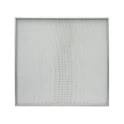
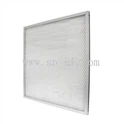
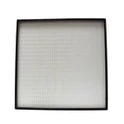
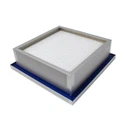
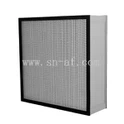
Hey there! As a supplier of H13 Mini - Pleat HEPA Filters, I often get asked about the pressure drop of these filters. So, I thought I'd write this blog to break it down for you.
First off, let's talk about what a H13 Mini - Pleat HEPA Filter is. H13 Mini-Pleat HEPA Filter is a high - efficiency particulate air filter. It's designed to capture at least 99.97% of particles that are 0.3 microns in diameter. The "mini - pleat" design means that the filter media is folded into a large number of small pleats. This increases the surface area of the filter, allowing it to capture more particles without sacrificing airflow too much.
Now, what exactly is pressure drop? Pressure drop is the difference in pressure between the upstream and downstream sides of a filter. When air passes through a filter, it has to overcome the resistance created by the filter media and the pleats. This resistance causes a drop in pressure. You can think of it like trying to push water through a straw. If the straw is clogged or has a small opening, you'll have to push harder, and there'll be a bigger difference in pressure between the two ends of the straw.
For a H13 Mini - Pleat HEPA Filter, the pressure drop is an important factor. A high pressure drop means that the fan or blower used to move the air through the filter has to work harder. This leads to higher energy consumption and can also cause more wear and tear on the equipment. On the other hand, a very low pressure drop might indicate that the filter isn't capturing particles effectively.
The pressure drop of a H13 Mini - Pleat HEPA Filter depends on several factors. One of the main factors is the filter's initial resistance. When a filter is brand new, it has a certain amount of resistance to airflow. This is determined by the type of filter media, the number of pleats, and the pleat spacing. For example, a filter with a denser media or more pleats will generally have a higher initial pressure drop.
Another factor is the dust loading. As the filter captures particles, the dust accumulates on the filter media. This increases the resistance to airflow and causes the pressure drop to rise over time. The rate at which the pressure drop increases depends on the concentration of particles in the air and the efficiency of the filter. A H13 Mini - Pleat HEPA Filter is very efficient at capturing particles, but that also means it can get clogged up faster in a high - dust environment.
Let's compare the H13 Mini - Pleat HEPA Filter with other types of filters. Separator HEPA Filter is another type of HEPA filter. Separator HEPA Filters use separators (usually made of aluminum or paper) to keep the pleats apart. These separators add to the structural integrity of the filter but can also increase the pressure drop compared to a mini - pleat filter. The mini - pleat design of the H13 filter allows for a more compact and efficient use of space, which can result in a lower pressure drop for the same filtration efficiency.
H11 Mini-Pleat Filter is also a popular option. H11 filters have a slightly lower efficiency compared to H13 filters. They capture at least 95% of particles that are 0.3 microns in diameter. Generally, H11 filters have a lower pressure drop than H13 filters because the filter media is less dense. However, if you need a higher level of filtration, like in a cleanroom or a hospital operating room, the H13 Mini - Pleat HEPA Filter is the way to go, even though it might have a higher pressure drop.
To measure the pressure drop of a H13 Mini - Pleat HEPA Filter, you can use a differential pressure gauge. This device measures the difference in pressure between the upstream and downstream sides of the filter. It's a good idea to monitor the pressure drop regularly, especially in applications where the filter is critical for maintaining air quality. When the pressure drop reaches a certain level, it might be time to replace the filter.
So, how can you manage the pressure drop of a H13 Mini - Pleat HEPA Filter? One way is to choose the right filter for your application. Consider the air quality requirements, the airflow rate, and the expected dust loading. If you're in a low - dust environment, you might be able to get away with a filter with a slightly higher initial pressure drop because it won't clog up as quickly.
Another way is to use pre - filters. Pre - filters are installed upstream of the H13 Mini - Pleat HEPA Filter. They capture the larger particles, reducing the dust loading on the HEPA filter. This can extend the life of the HEPA filter and keep the pressure drop in check.


In conclusion, the pressure drop of a H13 Mini - Pleat HEPA Filter is an important consideration when it comes to energy efficiency, equipment performance, and filtration effectiveness. By understanding the factors that affect pressure drop and taking steps to manage it, you can get the most out of your filter.
If you're interested in purchasing H13 Mini - Pleat HEPA Filters or have any questions about pressure drop or filtration in general, feel free to reach out. We're here to help you find the best solution for your needs.
References
- ASHRAE Handbook - HVAC Systems and Equipment
- Manufacturer's specifications for H13 Mini - Pleat HEPA Filters