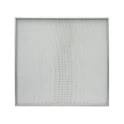
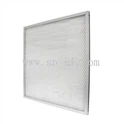
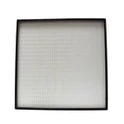
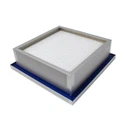
Hey there! As a supplier of H14 Mini - Pleat HEPA Filters, I often get asked about how to test the integrity of these filters. Well, you've come to the right place! In this blog, I'll walk you through the different methods and why they matter.
First off, let's understand why testing the integrity of an H14 Mini-Pleat HEPA Filter is so crucial. These filters are designed to trap extremely small particles, often down to 0.3 microns in size, with an efficiency of 99.995% or higher. That's super impressive, but if there's a leak or a defect in the filter, it won't work as intended. And in environments like hospitals, cleanrooms, or high - tech manufacturing facilities, a faulty filter can lead to serious problems, like contamination of products or spread of harmful particles.
Particle Counting Method
One of the most common ways to test the integrity of an H14 Mini - Pleat HEPA Filter is the particle counting method. This involves using a particle counter, which is a device that can measure the number and size of particles in the air.
Here's how it works. First, you need to set up the test environment. Make sure the area is clean and free from any sources of contamination. You'll also need to install the filter in a test rig, which is basically a frame that holds the filter in place and allows air to flow through it.
Once the filter is installed, you start by measuring the particle concentration upstream of the filter. This means you're measuring the number of particles in the air before it passes through the filter. You do this by placing the particle counter at a specific distance from the filter inlet.
After getting the upstream particle count, you then measure the particle concentration downstream of the filter. This is the number of particles in the air after it has passed through the filter. You place the particle counter at the outlet of the filter.
The integrity of the filter is then determined by comparing the upstream and downstream particle counts. If the downstream particle count is significantly higher than what's expected based on the filter's rated efficiency, there's likely a leak in the filter.
DOP (Dioctyl Phthalate) or PAO (Polalphaolefin) Testing
Another well - known method is the DOP or PAO testing. Historically, DOP was used, but due to its potential health risks, PAO has become the more popular choice in recent years.
This test involves generating a controlled aerosol of DOP or PAO upstream of the filter. The aerosol consists of tiny particles that are similar in size to the particles the filter is designed to capture.
As the aerosol - laden air passes through the filter, a photometer is used to measure the concentration of the aerosol downstream of the filter. The photometer works by shining a light through the air and measuring how much of the light is scattered by the particles.
If the filter is intact, the photometer will detect a very low concentration of the aerosol downstream. But if there's a leak, the concentration will be higher.
Pressure Drop Testing
Pressure drop testing is also an important part of checking the integrity of an H14 Mini - Pleat HEPA Filter. The pressure drop across a filter is the difference in air pressure between the upstream and downstream sides of the filter.
When a filter is new and clean, it has a certain pressure drop value. As the filter captures more and more particles over time, the pressure drop increases. This is because the particles clog the filter media, making it harder for air to pass through.
To perform a pressure drop test, you use a differential pressure gauge. You connect one end of the gauge to the upstream side of the filter and the other end to the downstream side. The gauge then measures the pressure difference.
If the pressure drop is much higher than the expected value for a clean filter, it could indicate that the filter is clogged. On the other hand, if the pressure drop is much lower than expected, it might be a sign of a leak in the filter.
Visual Inspection
Don't underestimate the power of a good old - fashioned visual inspection. This is a simple but effective way to check for obvious signs of damage or defects in the filter.
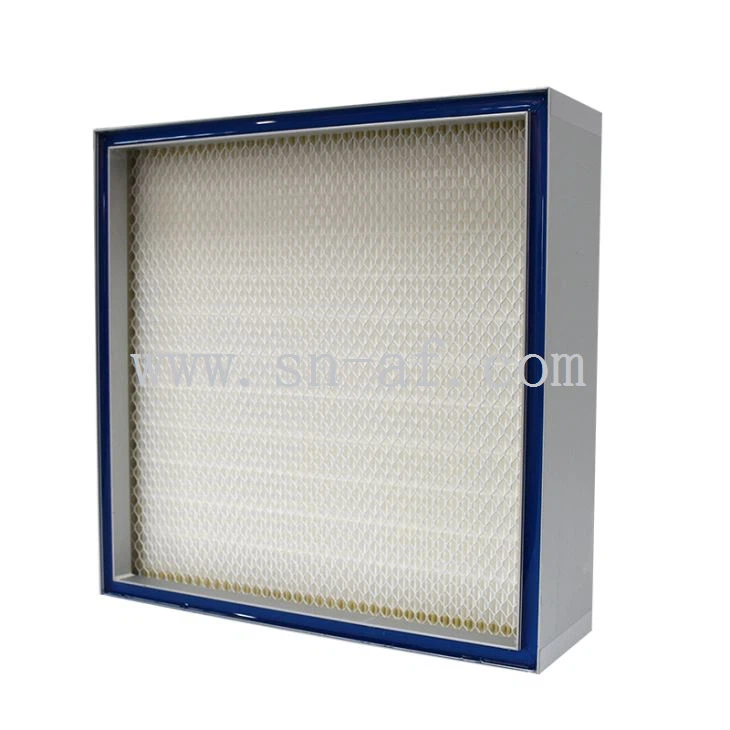
When you visually inspect an H14 Mini - Pleat HEPA Filter, you're looking for things like torn or damaged filter media, loose seals, or bent frames. You can use a flashlight to get a better look at the filter, especially in hard - to - reach areas.
If you notice any of these issues during the visual inspection, it's a clear indication that the filter may not be functioning properly and may need to be replaced.
Comparison with Other Filters
Sometimes, it can be helpful to compare the performance of an H14 Mini - Pleat HEPA Filter with other similar filters. For example, you can compare it with an H11 Mini-Pleat Filter.
H11 filters have a lower efficiency rating compared to H14 filters. By running the same tests on both types of filters and comparing the results, you can get a better understanding of how well the H14 filter is performing.
If the H14 filter is not performing significantly better than the H11 filter in terms of particle capture, it could be a sign that there's an issue with the H14 filter's integrity.
Importance of Regular Testing
Regular testing of H14 Mini - Pleat HEPA Filters is essential. Filters can degrade over time due to factors like dust accumulation, humidity, and mechanical stress. By testing the filters regularly, you can catch any issues early and replace the filters before they fail completely.
In addition to ensuring the proper functioning of the filters, regular testing also helps to maintain the quality of the air in the environment. This is especially important in applications where clean air is critical, such as in pharmaceutical manufacturing or semiconductor production.
Other Related Filters
While we're on the topic of filters, it's worth mentioning another type of filter, the Gel Seal HEPA Filter. These filters use a gel sealant to ensure a tight fit and prevent air leakage around the edges of the filter.
Gel seal HEPA filters are often used in applications where a high level of airtightness is required. The testing methods for gel seal HEPA filters are similar to those for H14 Mini - Pleat HEPA Filters, but the focus is also on checking the integrity of the gel seal.

Conclusion
Testing the integrity of an H14 Mini - Pleat HEPA Filter is a multi - step process that involves a combination of methods. Whether you're using particle counting, DOP/PAO testing, pressure drop testing, or visual inspection, each method plays a crucial role in ensuring that the filter is working as it should.
If you're in the market for high - quality H14 Mini - Pleat HEPA Filters or need more information about filter testing, don't hesitate to reach out. We're here to help you make the right choice for your specific needs. Whether you're a small business or a large industrial facility, we've got the expertise and the products to meet your requirements. So, let's start a conversation and see how we can work together to keep your air clean and your operations running smoothly.
References
- "High - Efficiency Particulate Air (HEPA) Filters: Principles and Performance" - Published by a leading research institute in the field of air filtration.
- "Testing Methods for Air Filters" - A comprehensive guide on various air filter testing techniques.