The diffusion effect of dust with small particle size is obvious. When the wind speed is low, the airflow will stay in the filter material for a longer time, and the dust will have more chances to hit obstacles. Therefore, the filtration efficiency is high. Experience has shown that for hepa filters, where the wind speed is reduced by half, the dust transmittance will be reduced by nearly an order of magnitude (an increase of 9 in the efficiency value), and that for a doubling of the wind speed, the transmittance will be increased by an order of magnitude (an increase of 9 in efficiency).
Similar to the diffusion effect, when the filter material is electrostatic (electret material), the longer the dust stays in the filter material, the more likely it is to be absorbed by the material. If the wind speed is changed, the filtration efficiency of materials with static electricity will be changed obviously. If you know that there is static electricity on the material, the air conditioning system should be designed to minimize the amount of air that passes through each filter.
According to the traditional theory, when the wind speed is reduced, the probability of dust collision with the fiber will be reduced, and the filtration efficiency will be reduced. But in practice this effect is not obvious, because the wind speed is lower, the fiber has less rebound to the dust, and the dust is more likely to stick.
Wind speed is high, resistance is big. If the service life of the filter is based on the terminal resistance and the wind speed is high, the service life of the filter is short. It is difficult for the average user to actually observe the effect of wind speed on filtration efficiency, but it is much easier to observe the effect of wind speed on resistance.
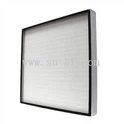
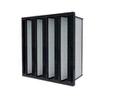
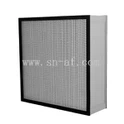
For the hepa filter, the velocity of airflow through the filter material is generally between 0.01 m and 0.04m/s. Within this range, the resistance of the filter is in direct proportion to the filtration air volume. For example, a 484×484×220mm high efficiency filter in Clean Norwich has an initial resistance of 250Pa at rated air volume of 1000m3/h. If the actual air volume in use is 500m3/h, its initial resistance can be reduced to 125Pa. For the general ventilation air conditioning box filter, air flow in the speed of filtering material within the range of 0.13 ~ 1.0 m/s, resistance and airflow is no longer a linear relationship, but a higher arc, air volume increased by 30%, the resistance could be increased by 50%, if the filter resistance is a very important parameter for you, you have to ask filter supplier for resistance curve.