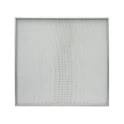
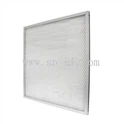
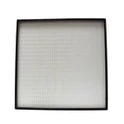
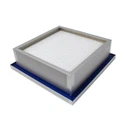
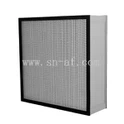
As a supplier of Pleat Primary Filters, I often encounter questions from customers regarding various aspects of these filters, and one question that frequently comes up is about the pleat spacing of a Pleat Primary Filter. In this blog post, I'll delve into what pleat spacing is, its significance, and how it impacts the performance of Pleat Primary Filters.
Understanding Pleat Spacing
Pleat spacing refers to the distance between consecutive pleats in a pleated filter. In a Pleat Primary Filter, the filter media is folded into pleats to increase the surface area available for capturing particles. The pleat spacing can vary depending on the design and intended application of the filter. A smaller pleat spacing means more pleats can be packed into a given area, resulting in a larger overall filtration surface area. Conversely, a larger pleat spacing means fewer pleats and a smaller filtration surface area within the same space.
Significance of Pleat Spacing
The pleat spacing plays a crucial role in determining the performance characteristics of a Pleat Primary Filter. Here are some key aspects influenced by pleat spacing:
Filtration Efficiency
A filter with a smaller pleat spacing generally offers higher filtration efficiency. This is because the increased surface area provided by the closely spaced pleats allows for more opportunities to capture particles as the air passes through the filter. The particles are more likely to come into contact with the filter media, increasing the probability of their removal from the air stream. For example, in applications where high levels of particulate matter need to be removed, such as in industrial settings or areas with poor air quality, a Pleat Primary Filter with a smaller pleat spacing can be highly effective.
Pressure Drop
Pressure drop is the resistance to airflow caused by the filter. A filter with a smaller pleat spacing typically has a higher pressure drop compared to one with a larger pleat spacing. This is because the closely spaced pleats restrict the flow of air more, requiring more energy to push the air through the filter. In systems where energy consumption is a concern, such as in HVAC systems, a balance needs to be struck between filtration efficiency and pressure drop. A filter with an appropriate pleat spacing can help optimize both factors, ensuring efficient filtration without excessive energy consumption.
Dust Holding Capacity
The dust holding capacity of a filter refers to the amount of dust and particulate matter it can hold before it needs to be replaced or cleaned. A filter with a larger pleat spacing generally has a higher dust holding capacity. This is because the wider spacing between the pleats allows for more space to accumulate dust without significantly increasing the pressure drop. In applications where the air contains a high concentration of dust, such as in construction sites or manufacturing facilities, a Pleat Primary Filter with a larger pleat spacing may be more suitable as it can operate for longer periods without requiring frequent replacement.
Factors Affecting Pleat Spacing Selection
When selecting the pleat spacing for a Pleat Primary Filter, several factors need to be considered:
Application Requirements
The specific application of the filter is a primary factor in determining the appropriate pleat spacing. For example, in a cleanroom environment where strict air quality standards must be met, a filter with a smaller pleat spacing may be required to achieve the necessary filtration efficiency. On the other hand, in a less critical application, such as a general ventilation system in an office building, a filter with a larger pleat spacing may be sufficient to provide adequate filtration while minimizing energy consumption.
Airflow Rate
The airflow rate through the filter also affects the choice of pleat spacing. Higher airflow rates generally require a larger pleat spacing to prevent excessive pressure drop. If the pleat spacing is too small for a high airflow rate, the filter may become clogged quickly, leading to a significant increase in pressure drop and reduced system performance.
Particle Size Distribution
The size distribution of the particles in the air being filtered is another important consideration. If the air contains a large proportion of small particles, a filter with a smaller pleat spacing may be more effective in capturing these particles. However, if the majority of the particles are larger, a filter with a larger pleat spacing may be sufficient.


Our Pleat Primary Filter Offerings
As a supplier of Pleat Primary Filters, we offer a range of products with different pleat spacings to meet the diverse needs of our customers. Our Synthetic Fiber Panel Pre Air Filter G4 is designed with an optimized pleat spacing to provide high filtration efficiency and a reasonable pressure drop. It is suitable for a variety of applications, including HVAC systems, commercial buildings, and industrial facilities.
Our Grease Metal Panels Filter is another option that offers excellent dust holding capacity and durability. The pleat spacing of this filter is designed to handle high levels of dust and grease, making it ideal for use in kitchens, restaurants, and food processing plants.
For applications where a flat panel filter is required, we offer the Synthetic Fiber Flat Panel Filter. This filter has a unique pleat design that provides a large filtration surface area while maintaining a low pressure drop. It is suitable for use in air handling units, ventilation systems, and other applications where space is limited.
Conclusion
In conclusion, the pleat spacing of a Pleat Primary Filter is a critical factor that affects its performance, including filtration efficiency, pressure drop, and dust holding capacity. When selecting a filter, it is important to consider the specific application requirements, airflow rate, and particle size distribution to choose the appropriate pleat spacing. As a supplier of Pleat Primary Filters, we are committed to providing high-quality products with optimized pleat spacings to meet the needs of our customers.
If you are interested in learning more about our Pleat Primary Filters or would like to discuss your specific filtration requirements, please feel free to contact us. We look forward to working with you to provide the best filtration solutions for your needs.
References
- "Filtration Handbook" by Peter A. Schweitzer
- "Air Filtration: An Introduction for Engineers" by David W. Cooper and F. C. Alley