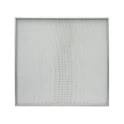
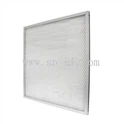
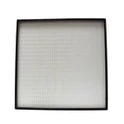
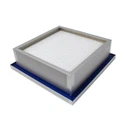
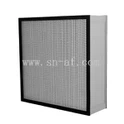
In the field of air filtration, the choice between different types of filters can significantly impact the quality of air purification. Two commonly discussed filters are the U15 Mini - Pleat ULPA Filter and the HEPA filter. As a supplier of U15 Mini - Pleat ULPA Filters, I am well - versed in the characteristics of both and can provide a detailed comparison.
1. Filtration Efficiency
The most fundamental difference between the U15 Mini - Pleat ULPA Filter and the HEPA filter lies in their filtration efficiency.
HEPA, which stands for High - Efficiency Particulate Air, is a standard for air filters. A HEPA filter is designed to trap at least 99.97% of particles that are 0.3 microns in diameter. This is a remarkable achievement in air filtration, as it can effectively remove many common pollutants such as dust, pollen, mold spores, and some bacteria from the air. However, the U15 Mini - Pleat ULPA Filter takes filtration to a whole new level.
ULPA stands for Ultra - Low Penetration Air. The U15 Mini - Pleat ULPA Filter has a much higher filtration efficiency compared to a HEPA filter. It can capture at least 99.9995% of particles that are 0.12 microns in diameter. This means that the U15 Mini - Pleat ULPA Filter can remove even smaller and more harmful particles, such as viruses, fine particulate matter (PM2.5 and PM1), and sub - micron aerosols, from the air with greater precision.
For industries that require extremely clean air, such as semiconductor manufacturing, pharmaceutical production, and biotechnology research, the U15 Mini - Pleat ULPA Filter is often the preferred choice. In semiconductor manufacturing, for example, even the smallest particle can cause defects in the microchips being produced. A HEPA filter may not be sufficient to meet the stringent air quality requirements, while the U15 Mini - Pleat ULPA Filter can provide the high - level filtration needed to ensure the quality of the products.
2. Structure and Design
The structure of the U15 Mini - Pleat ULPA Filter and the HEPA filter also shows significant differences.
A HEPA filter typically consists of a mat of randomly arranged fibers. These fibers are usually made of materials such as fiberglass. The random arrangement of the fibers creates a maze - like structure through which air must pass. As the air flows through the filter, particles are trapped by the fibers through a combination of mechanisms, including interception, impaction, and diffusion.
On the other hand, the U15 Mini - Pleat ULPA Filter has a more advanced and precise design. The “mini - pleat” design is a key feature. It consists of multiple pleats that are closely spaced. This design increases the surface area of the filter, allowing for more efficient filtration. The pleats are often made of high - performance materials that are specifically engineered to capture ultra - fine particles.
The increased surface area of the U15 Mini - Pleat ULPA Filter not only enhances its filtration efficiency but also helps to reduce the pressure drop across the filter. A lower pressure drop means that the filter requires less energy to operate, which can result in cost savings in the long run. Additionally, the mini - pleat design makes the filter more compact, which is beneficial for applications where space is limited.
3. Application Scenarios
The differences in filtration efficiency and structure lead to different application scenarios for the U15 Mini - Pleat ULPA Filter and the HEPA filter.
HEPA filters are widely used in a variety of settings, including residential air purifiers, commercial HVAC systems, and some general industrial applications. In homes, a HEPA - equipped air purifier can effectively improve indoor air quality by removing common allergens and pollutants. In commercial buildings, HEPA filters are used in HVAC systems to provide clean air for occupants.
However, the U15 Mini - Pleat ULPA Filter is mainly used in industries with high - purity air requirements. In the pharmaceutical industry, for instance, the production of sterile drugs requires an environment with extremely low levels of particulate contamination. The U15 Mini - Pleat ULPA Filter can be used in cleanrooms to ensure that the air is free from harmful particles that could contaminate the drugs.
In the semiconductor industry, as mentioned earlier, the manufacturing process of microchips is highly sensitive to particle contamination. The U15 Mini - Pleat ULPA Filter is used in cleanrooms and semiconductor manufacturing equipment to maintain the required air quality levels.


4. Cost Considerations
When it comes to cost, the U15 Mini - Pleat ULPA Filter is generally more expensive than a HEPA filter.
The higher cost of the U15 Mini - Pleat ULPA Filter is mainly due to its advanced materials and manufacturing processes. The materials used in the U15 Mini - Pleat ULPA Filter are of higher quality and are specifically designed to achieve the high filtration efficiency. The manufacturing process also requires more precision and quality control to ensure that the filter meets the strict ULPA standards.
In addition to the initial purchase cost, the replacement cost of the U15 Mini - Pleat ULPA Filter is also relatively high. However, for industries that cannot afford any compromise on air quality, the benefits of using the U15 Mini - Pleat ULPA Filter often outweigh the cost. The improved product quality, reduced risk of contamination, and compliance with industry regulations make the investment in the U15 Mini - Pleat ULPA Filter worthwhile.
5. Maintenance and Lifespan
The maintenance requirements and lifespan of the U15 Mini - Pleat ULPA Filter and the HEPA filter also differ.
A HEPA filter usually has a relatively longer lifespan under normal operating conditions. However, its performance may gradually decline over time as it accumulates particles. When the pressure drop across the HEPA filter reaches a certain level, it needs to be replaced.
The U15 Mini - Pleat ULPA Filter, due to its high filtration efficiency, may accumulate particles more quickly, especially in environments with high levels of particulate contamination. As a result, it may require more frequent replacement. However, proper maintenance, such as regular inspection and monitoring of the pressure drop, can help to extend the lifespan of the U15 Mini - Pleat ULPA Filter.
Conclusion
In conclusion, the U15 Mini - Pleat ULPA Filter and the HEPA filter have distinct differences in filtration efficiency, structure, application scenarios, cost, and maintenance. The U15 Mini - Pleat ULPA Filter offers superior filtration performance, making it the ideal choice for industries with high - purity air requirements. If you are in an industry that demands the highest level of air quality, such as semiconductor manufacturing, pharmaceutical production, or biotechnology research, the U15 Mini - Pleat ULPA Filter is a reliable solution. We also offer U16 Mini - Pleat ULPA Filter and U17 Mini - Pleat ULPA Filter for even more demanding applications.
If you are interested in learning more about our U15 Mini - Pleat ULPA Filters or would like to discuss your specific air filtration needs, please feel free to contact us for a detailed negotiation. We are committed to providing you with the best air filtration solutions.
References
- “Fundamentals of Air Filtration” by the American Filtration & Separations Society.
- “Air Filtration in Cleanrooms” by the International Society for Pharmaceutical Engineering.
- Industry reports on air filtration technology and applications.