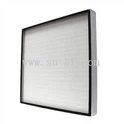
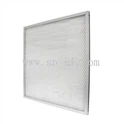
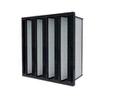
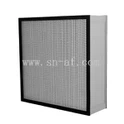
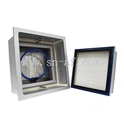
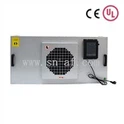
The Pao aerosol is sent to the upstream end of the hepa filter to be tested as a dust source. When the aerosol mixture is uniform, that is, the concentration value of the upstream is stable, the aerosol photometer is used for detection, and the concentration value is set to 100% reference value. Do not adjust the Pao aerosol concentration after setting the upstream concentration. A photometer is used to scan the downstream of the hepa filter point by point to detect aerosol concentration. The ratio of the downstream concentration to the set upstream concentration is the leakage rate of the hepa filter (also known as transmittance).
two To test the leak rate of the hepa filter, three conditions must be met:
1. It can introduce aerosol into the system. The best place to introduce aerosols is at the negative pressure end of the fan. At this point, the dust particles generated by the generator can be inhaled into the system through the fan, and the aerosol has little interference with the environment. Evenly mixed air and fog; The production of dust does not need positive pressure closed environment, so the difficulty of dust production is lower. For example: FFU air inlet, clean table air inlet and so on.
In some places where the conditions are not met, dust generation can only be carried out near the hepa filter. At this time, it is necessary to overcome the airflow pressure on the upper end of the hepa filter and press the aerosol into the static pressure box, making the dust generation more difficult. When dust is generated, more aerosols leak into the field test environment, and the aerosol concentration in the environment is very high, which is easy to cause interference to the test. Aerosol mixing is not uniform, the upstream concentration is high, volatile. We recommend that you do not dust here unless you must.
Some equipment manufacturers do not have relevant testing experience, so setting the aerosol dust generation port at the positive pressure end of the fan may cause a lot of unnecessary trouble in testing. Therefore, when preparing urs for the equipment, this point must be written down and the equipment manufacturer is required to set the dust outlet at the negative pressure end of the fan, so as to create favorable conditions for future verification.
2. Stable upstream aerosol concentration can be detected. The upstream concentration test port is located near the upstream end of the hepa filter and is connected to a location where it is easy to sample through a hose, such as a static pressure box at the air supply outlet of the purification air conditioning system room. Some older static tanks do not have upstream concentration testing ports, so the static tanks must be restructured.
3. The downstream filter outlet of the hepa filter can be scanned point by point. If a point-by-point scan can be performed, the leak rate at any location of the hepa filter, including the frame, can be measured. Point-by-point scanning is not possible if the hepa filter for a small number of production units is located inside the unit. At this point, the total leakage rate of the filter can only be tested in the outlet of the equipment.