According to the “Operation management guidelines for air conditioning and ventilation system in office premises and public places during the epidemic period of NCP (Novel Coronavirus Pneumonia)” issued by the National Health Commission required:
To prevent the NCP from spreading and spreading due to the opening of the air conditioning and ventilation system, the air return valve should be closed and the new air mode operated when the air conditioning and ventilation system is the whole air system.
Many enterprises have clean rooms, especially high-end manufacturing industries such as precision machinery and semiconductor. Clean room is a typical place where all air central air conditioning is used. Air conditioning is an essential facility in clean room. Return air system is an important guarantee to reduce energy consumption, reduce filter pressure and control cleanliness.
Does the clean room air conditioning system need to turn off the return air?
What is the risk of NCP?
This is what many enterprises returning to work want to know about!
Don't worry. Let's talk about it.
Clean rooms
Clean room refers to a closed room in which the concentration of suspended particles in the air is controlled and the parameters such as temperature, humidity and pressure can be controlled as required. It is widely used in military industry, electronics, semiconductor, optics, aerospace, micro bearing, micro motor, photosensitive film, ultrapure chemical reagent, medical treatment, pharmacy, food and biochemistry, medicine, life science and other fields. It is the standard configuration of high-end manufacturing industry.
Do you need to turn off the return air?
For clean rooms, the proportion of fresh air is generally 10 ~ 50%. In order to solve the panic of cross infection and eliminate the doubts of the return air system, either close the return air and use fresh air operation, or ensure that the harmful substances can be effectively diluted or filtered.
The first method of closing return air can effectively dilute harmful substances and eliminate cross infection. However, there are many problems, which may lead to the following situations:
1. If the pressure difference of clean room is too large, the pressure cannot be released, which will eventually lead to the decrease of fresh air volume;
2. With the increase of filter pressure, more frequent replacement or maintenance is needed to reduce the resistance;
3. When the temperature difference between inside and outside of the solar term is large, the air conditioning load will increase sharply, which will lead to a series of situations, such as excessive system pressure or unqualified cooling / heating;
4. For some workshops with high cleanliness, such as some integrated circuits, precision equipment and other industries, the unidirectional air flow pattern adopted is damaged.
This series of problems may lead to clean room cleanliness and temperature and humidity cannot meet the production requirements, thus damaging the production environment, resulting in product quality degradation, and may also lead to excessive load of power facilities of air conditioning system and damage to equipment.
What about the risk?
So, if you choose not to turn off the return air, is it really that bad?
People are afraid of the novel coronavirus, on the one hand, it is highly pathogenic, and on the other hand, it has strong transmission capacity. According to the seventh edition of the National Health Commission diagnosis and treatment program, the transmission of novel coronavirus includes contact transmission, droplet transmission,aerosol transmission (possible), "fecal mouth" transmission (possible).
For central air-conditioning systems, aerosol propagation can be fatal. The group novel coronavirus pneumonia incident occurred in the Japanese Diamond Princess Cruise and the Shandong city jail, and it is clear that closed environment, long time exposure and high concentration aerosol environment are the conditions for the transmission of novel coronavirus through aerosols. Clean room environment naturally has the first two conditions, can solve the problem of cross infection, and mainly depends on the ability to dilute the virus.
The dilution capacity of clean room air conditioning system is closely related to fresh air volume, air distribution and filtration efficiency. The main parameters related to fresh air are as follows:
1. Fresh air volume. It is used to compensate the exhaust air volume and maintain the differential pressure to meet the per capita fresh air volume ≥ 40m3 / h.
2. Differential pressure requirements. The pressure difference between clean rooms of different grades, between clean area and non clean area should not be less than 5pa, and that between clean area and outdoor should not be less than 10Pa.
3. Air flow pattern. The cleaning grade is 1-5, using unidirectional flow; the cleanliness level is 6-9, using non unidirectional flow.
4. Air changes. For the clean rooms with floor height less than 4 meters, the air change times of Grade 8 and 9 clean rooms are 10 ~ 15 times / h, and those of grade 6 and above are more than 50 times / h.
5. Filter. Generally, the combination of "coarse filter + medium filter + high (sub high efficiency, ultra high efficiency) filter" is adopted.
01
Fresh air dilution effect
Taking 30% of the normal fresh air volume as an example, the fresh air exchange rate of 7-9 clean rooms is ≫ 3 times / h, and that of clean rooms above grade 6 is ≫ 15 times / h. In addition, the air distribution of clean room is mostly unidirectional flow (piston type) with upper supply and lower return or upper supply side return. The dilution of fresh air is far better than that of ordinary air-conditioned room, which can meet the requirements.
02
Filtration dilution effect
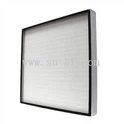
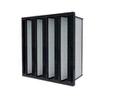
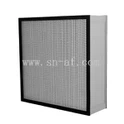
The air-conditioning system of clean room has at least three-stage filter, and the lowest is sub high efficiency or high-efficiency filter. The filtration effect of sub high-efficiency filter is 85-98% for 0.3um particles, and 99.9-99.997% for high-efficiency filter. Compared with the commonly used masks, medical surgical masks are 30%, N95 and medical protective masks are 95%. The effect of high-efficiency filters is far better than ordinary masks and there will be no tightness problem, so the dilution effect of the filter on the virus is very obvious.
Virus transmission cannot be separated from an important factor, that is, the amount of virus. In a well ventilated place, on the one hand, it is difficult for the virus to survive in the air for a long time. On the other hand, the virus is quickly diluted, and it is difficult to gather to reach the dose of infected people. We all know that "talking about toxicity without dose is playing rogue". The current cases show that the possibility of aerosol transmission in well ventilated places is relatively small.
For the clean room, the virus concentration can be effectively diluted by dilution and filtration when the fresh air is on and the filter is effective, which will not increase the risk of cross infection.