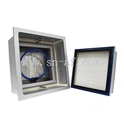
Installation and sealing of HEPA filter
The installation and sealing of HEPA filter is the key to air purification and also a difficult point for a long time. The leak detection after filter installation is the most difficult test to pass. The failure of many clean rooms is due to poor sealing. Even if the cleanliness is up to standard, its leak detection may not be up to standard. This may not be a big problem in other cleanrooms, but in the pharmaceutical industry, the leakage of biological cleanrooms means bacteria, so sealing is the key to biological cleanrooms.
At present, the commonly used sealing methods are:
1. Contact packing seal
The effect is average. More used by HEPA Box.
The packing used for sealing includes solid sealing gasket (such as neoprene plate, closed cell sponge rubber plate, etc.) and liquid sealant (such as silicone rubber, neoprene rubber, natural rubber).
Solid sealing gasket is generally mechanically compressed by bolts, and the compression of rubber plate is 30%~50%.
Liquid sealant is sealed by filling and adhesion methods.
2. Liquid groove knife edge seal
The effect is good, but the construction is difficult. The sealing effect is often affected by construction. In the production of HEPA filter, this method has great advantages in air leakage inspection, good sealing effect, quick and convenient installation and removal in a short time.
A certain height of sealing liquid is injected into the slot frame, and the knife edge of the HEPA filter is inserted into the sealing liquid, so that the air passage on both sides is blocked to achieve the purpose of sealing.
This method is generally used for the sealing of clean rooms with Grade 100, Grade 10 and higher cleanliness.

HEPA Filter Liquid groove seal
3. Negative pressure leakage seal
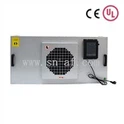
The effect is the best, and FFU is its typical representative.
This "sealing" method is to use the air leaked from the positive pressure space to artificially dredge the negative pressure space outside the work area to ensure that the work area is not polluted. It is generally used for small scale clean room sealing, such as negative pressure ceiling.

Schematic diagram of negative pressure seal