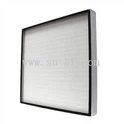
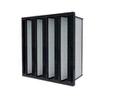
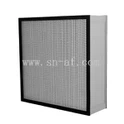
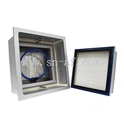
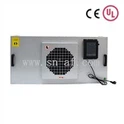
A HEPA (High Efficiency Particulate Air) filter is a type of mechanical air filter designed to capture and remove a wide range of airborne particles, including dust, pollen, pet dander, smoke, and allergens. Here's how a HEPA filter works:
Filter Construction: HEPA filters are constructed using a dense mat of very fine fibers. These fibers are usually made of materials like fiberglass, paper, or synthetic polymers. The fibers are arranged in a random pattern to create a maze-like structure with countless small passages.
Mechanical Filtration: HEPA filters work through mechanical filtration. As air passes through the filter, particles in the air are forced to follow the airflow pattern. The fine fibers in the filter act like obstacles or traps that particles must navigate.
Particle Capture: Particles in the air that are larger than the gaps between the fibers are captured by the filter. HEPA filters are designed to capture particles as small as 0.3 microns (micrometers) with high efficiency. This includes particles like dust mites, pollen, mold spores, pet dander, and some bacteria.
Diffusion and Interception: Smaller particles, which are smaller than the gaps between the fibers, are not captured solely due to size. Instead, they follow a zigzag path due to a phenomenon called diffusion. Additionally, some particles are intercepted by the fibers as they come into contact with them.
Multiple Passes: To ensure effective filtration, air often passes through a HEPA filter multiple times in an air purifier. This increases the chances of capturing particles, even those that may have initially escaped.
High Efficiency: HEPA filters are designed to be highly efficient, typically capturing at least 99.97% of particles that are 0.3 microns in size. They are even more effective at capturing larger particles.
Clean Air Output: After passing through the HEPA filter, the purified air is released back into the room, free of the captured particles. This results in improved indoor air quality.
HEPA filters are widely used in various applications, including air purifiers, vacuum cleaners, HVAC systems, and cleanrooms. They are known for their effectiveness in removing airborne allergens and contaminants, making them a popular choice for individuals looking to improve the air quality in their homes or workplaces. Proper maintenance and regular replacement of HEPA filters are essential to maintain their filtration efficiency over time.